
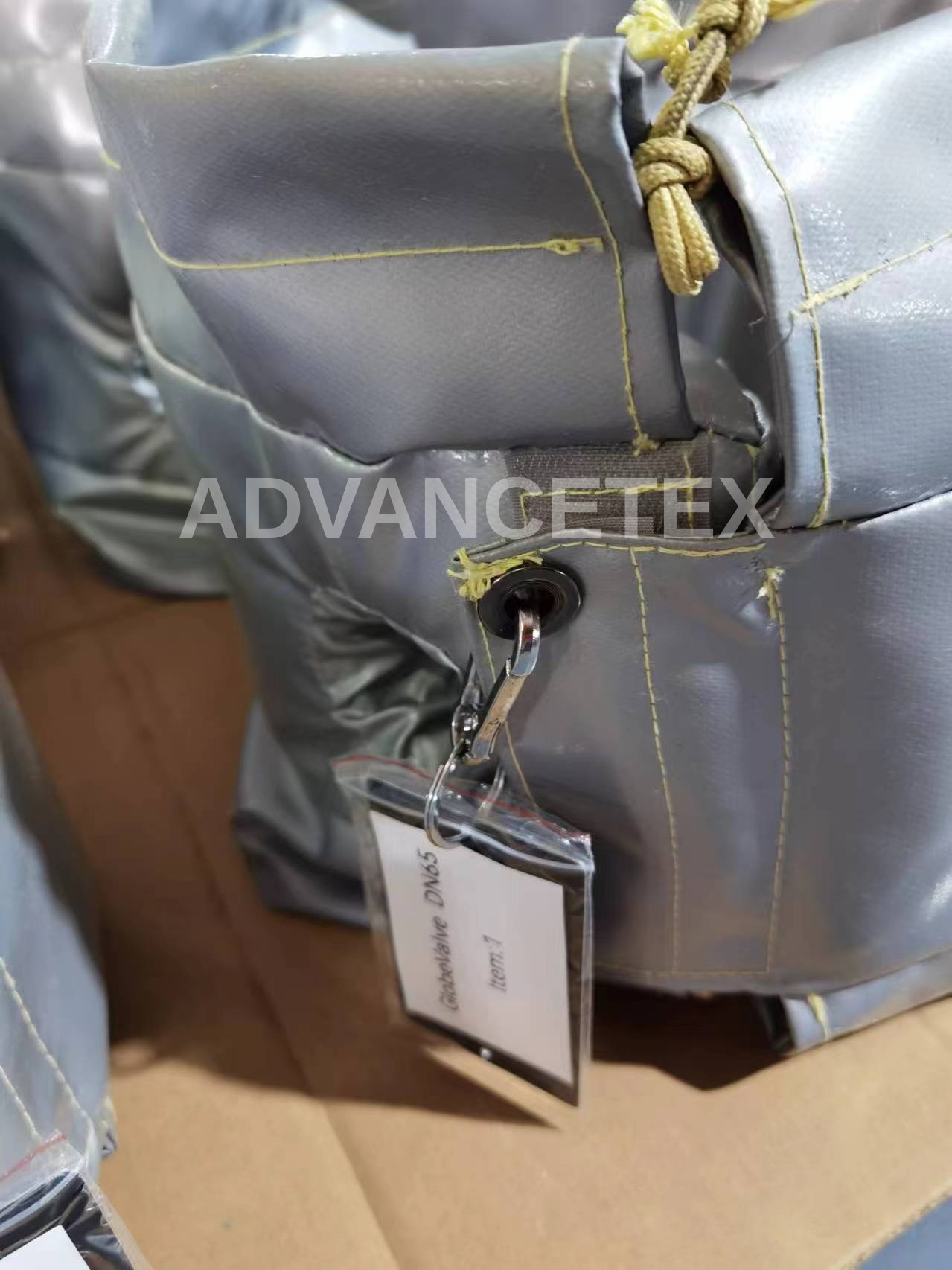
A removable valve jacket from one of our export orders: grey PTFE-coated outer fabric, yellow aramid stitching, hook-and-loop flap, drawcord, eyelet with snap hook, and an item tag reading "GlobeValve DN65 – Item 1".
Datasheets tell you what a fabric is. A finished jacket tells you what the fabric has to do. The valve jacket above came off our own sewing line for an export order, and almost every detail in the photo answers a question that jacket makers ask before they switch or add a fabric. This article walks through those details and turns them into a short checklist for your first trial jacket.
1. The coated face goes out – and you should be able to see which face is which
Our grey jacket fabric is single-sided: PTFE on one face, woven fiberglass on the other. On an outer layer, the PTFE face normally faces the environment. That is the side that meets rain, oil mist, dust and cleaning, and it is the side that stays easy to wipe down.
Mistakes happen at the cutting table, not on the drawing. Two habits help:
- Mark "coated face" on every cut piece before it leaves the table, especially mirrored pieces.
- Choose a grade where the two faces are easy to tell apart. On ADP-001 the coated face is dark grey and the back is black fiberglass, so cut edges do not show light-colored fibers. ADP-002, ADP-003 and ADP-004 have medium grey, light grey and silver grey faces with a natural tan back.
All four grades are 0.40 mm thick (about 16 mil). The manufacturer-stated service range of −70 °C to +260 °C applies to the PTFE-coated face. The rating of the finished jacket also depends on its thread, closures and the other layers.
2. Thread: we sew these jackets with aramid thread
The yellow stitching in the photo is aramid thread. It is a common choice for insulation jackets because it holds its strength at elevated temperatures far better than ordinary polyester sewing thread. Two practical points:
- Check the thread manufacturer's rating against the highest expected temperature at the seam, including local hot spots or contact with hot components.
- A contrasting thread color makes inspection easier. Skipped stitches, loose ends and damaged seams are easy to see on grey fabric.
3. Closures decide whether a jacket stays "removable"
A removable jacket is only useful if maintenance staff can take it off and put it back quickly, and get the same fit every time. The jacket in the photo combines three types of closure, each with a different job:
- Hook-and-loop flap: fast closing along the main overlap. Standard hook-and-loop generally has a lower temperature limit than PTFE-coated fiberglass. Check the specific fastener rating against the highest expected temperature where it is installed; an outer overlap is not necessarily cool enough. Use a suitable high-temperature version or another closure when needed.
- Drawcord: pulls the jacket ends tight around the pipe or valve body, so the jacket does not slide and leave gaps.
- Eyelet and snap hook: a mechanical connection that also takes the item tag. The eyelet is positioned at a stitched tab. Check the reinforcement around the hardware and inspect this area under the expected fastening load during the trial.
When you trial-sew, include the closures. A straight seam on a flat swatch will not show you whether a flap still lines up after the jacket is wrapped around a real valve.
4. Tag every piece to its drawing
The tag reads "GlobeValve DN65 – Item 1". On a plant with dozens of valves of similar size, matching each jacket's number to its drawing and installation position helps maintenance staff reinstall it correctly. Plan a secure tag attachment suitable for the jacket design and agree the numbering with the customer before cutting.
5. Make one complete trial jacket before cutting the batch
Swatches help you compare color and identify the two faces. A complete trial jacket lets you check cutting, sewing, closure alignment and fit. For your first piece in a new fabric, we suggest recording:
| Item | What to check |
|---|---|
| Material | Grade, coated-face orientation on every piece |
| Cutting | Edges after cutting, cut-outs for stems or handwheels, mirrored pieces |
| Sewing | Seam appearance, folds and corners, skipped stitches, thread used |
| Closures | Hook-and-loop alignment, drawcord fit, eyelet area after fastening |
| Fit | Installation and removal on the real part (or a mock-up) |
| Tag | Item number matches the drawing |
A room-temperature trial fit confirms construction and fit; it does not establish service life or temperature performance. Those depend on the project's own requirements.
6. Compare the four grey grades
We supply grey, single-sided PTFE-coated fiberglass and aramid sewing thread to insulation jacket makers. A4 swatches of all four grades are free and usually ship within a week; you cover only the courier cost.
To request swatches, email jacky@advancetex.co with the type of jacket you make, the grades you want to compare, the width and quantity you need, and your destination country. A photo of your current fabric helps us suggest which grades to compare.
Compare the four grades: https://www.advancetex.co/content/205.html
ADP-001, dark grey with black back: https://www.advancetex.co/content/887.html