
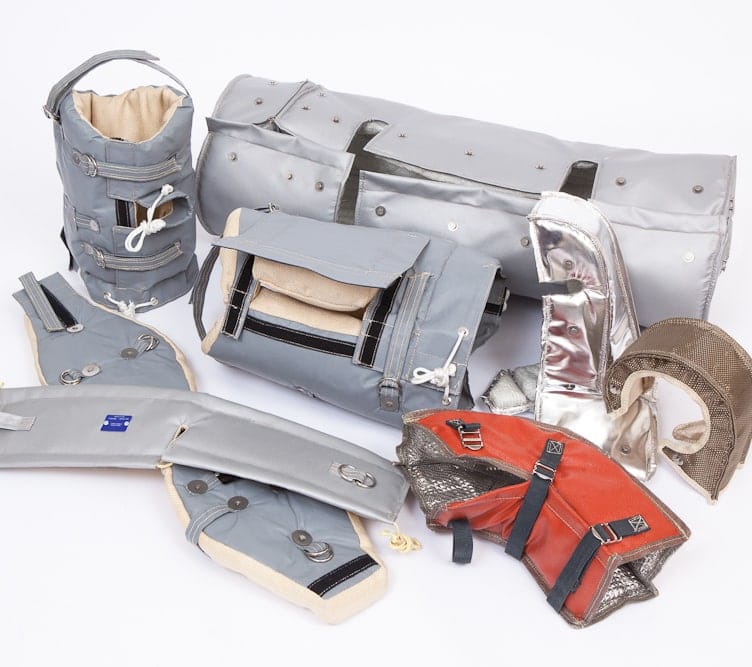
PTFE coated fiberglass fabric combines a high-strength woven fiberglass substrate with a sintered fluoropolymer coating. Engineered for demanding industrial environments, it provides continuous temperature resistance, exceptional chemical inertness (pH 0–14), a low friction coefficient, and long-term weatherability.
In the manufacturing of removable and reusable flexible insulation blankets (jackets), PTFE-coated fabric primarily serves as the protective outer jacketing or the corrosion-resistant inner contact layer. Due to PTFE's low surface energy and the shear characteristics of fiberglass yarns, specialized converting and fabrication techniques are required. This article outlines the primary processing methods and key engineering considerations.
1. Precision Cutting and Patterning
Removable insulation blankets must conform accurately to complex three-dimensional piping components, valves, flanges, and turbine casings.
- CNC Oscillating Knife Cold Cutting (Recommended): High-frequency oscillating knife cutters driven by CAD pattern layouts are the standard choice. This mechanical cold-cutting process prevents the release of fluorinated fumes associated with high-temperature degradation. It produces clean, sealed-edge cuts without yarn fraying. Cut tolerances are reliably maintained within engineering specifications depending on ply count and fabric weight.
- Die Cutting: Ideal for standardized, high-volume production of repetitive components, such as circular flange covers, sight-glass rings, and terminal clamping tabs.
- Limitations of Thermal and Laser Cutting: When exposed to thermal decomposition temperatures, PTFE releases irritant and corrosive fluorinated byproducts. Laser equipment manufacturers generally advise against processing untreated fluoropolymers unless the system is specifically rated and integrated with dedicated, high-efficiency local exhaust ventilation and scrubbing systems. Mechanical cutting remains the preferred baseline.
2. Industrial Sewing and Seaming Techniques
The low coefficient of friction of PTFE causes standard multi-ply fabrics to slip during feeding. Furthermore, excessive needle penetration can degrade the tensile strength of the underlying fiberglass weave.
Machinery and Feeding
- Compound-Feed / Walking Foot Machines: Industrial sewing machines equipped with synchronized upper and lower feed mechanisms are required to eliminate ply slippage and prevent uneven seams.
- Stitch Density: Stitch pitch must be determined through fabrication testing based on fabric thickness and weave density. Overly dense stitching cuts warp and weft fibers, reducing seam tear strength; overly loose stitching compromises seam tightness and structural retention.
High-Performance Sewing Thread Selection
Thermal and chemical exposure varies significantly across different zones of an insulation blanket. Thread selection should match the operating temperature of the specific seam:
- PTFE-Coated Fiberglass Thread: Offers minimal thermal elongation, high tensile stability, and matching thermal resistance. Suitable for continuous elevated-temperature zones.
- 100% Expanded PTFE (ePTFE) Thread: Chemically inert across the full pH spectrum and immune to UV radiation and chemical attack. Provides high flexibility for blankets subjected to frequent handling and cyclic flexure.
- Wire-Reinforced Hybrid Threads: Aramid or fiberglass cores reinforced with 316L stainless steel or Inconel wire. These are utilized in high-stress, high-vibration structural attachments.
3. Heat Sealing and Thermoplastic Bonding (Enhanced Ingress Protection)
Standard sewn seams inherently contain needle perforations. In outdoor installations, washdown zones, or environments exposed to acid mist, thermal welding processes can supplement or replace stitching to mitigate fluid ingress.
-
Bonding Mechanism: PTFE has an extremely high melt viscosity and does not flow or weld directly under conventional heat and pressure. Practical thermal seaming utilizes compatible thermoplastic fluoropolymer films (such as FEP or PFA) as intermediate hot-melt bonding media. Under controlled heat and pressure, the fluorothermoplastic melts and penetrates the surface structure, creating a continuous physical weld.
-
Temperature Compatibility: The long-term operating threshold of a welded seam is constrained by the intermediate bonding film:
-
Standard FEP films typically offer continuous temperature limits around 205°C (401°F).
-
Standard PFA films extend continuous temperature resistance up to approximately 260°C (500°F). Material selection must align strictly with the surface temperature profile of the jacket.
-
Risk Reduction vs. Hermeticity: A validated thermoplastic heat-sealed seam eliminates needle holes, substantially reducing the ingress of water, moisture, and chemical agents into the inner insulation core, thereby lowering the probability of Corrosion Under Insulation (CUI). However, actual containment performance depends on seam geometry, pressure validation, and quality control.
4. Edge Finishing and Hardware Integration
Because removable insulation jackets are modular systems subjected to routine inspection cycles, perimeter edges and fastening points must be mechanically secured.
-
Hemming vs. Edge Binding:
-
Hemming: Folding the raw edge inward for one or two folds before single- or double-needle topstitching. Standard for straight profiles.
-
Binding: Enclosing the raw edge with a secondary, thinner PTFE-coated tape or high-temperature synthetic webbing. Recommended for contoured radii, heavy-gauge fabrics, or cleanroom environments requiring complete encapsulation of edge fibers.
-
Coating Orientation: For single-sided coated fabrics, engineering drawings must designate whether the coated side faces outward (weather barrier) or inward (chemical contact), ensuring hems are folded accordingly.
-
Grommet and Hardware Punching: Perimeters are perforated using precision pneumatic or hydraulic punch tooling to install 304 or 316 stainless steel grommets (eyelets). These facilitate wire-lacing, tie cords, or D-ring anchors. In vertical piping runs or valve covers, lower perimeter grommets also serve as controlled drain ports for condensation.
-
Penetration and Aperture Reinforcement: Openings for test ports, thermocouple wires, and valve stems require localized reinforcement patches and flexible collars. These accommodate equipment movement while minimizing thermal bridging and convective heat loss.
5. Technical Fabrication Checklist
Before configuring materials and cutting orders, confirm the following technical parameters:
| Engineering Parameter | Key Selection Criteria |
|---|---|
| Fabric Specification | Coating profile (single-sided / double-sided / laminated), substrate thickness, weight, and minimum tensile strength |
| Seam Construction | Mechanical stitching (thread chemistry and flex requirements) vs. thermoplastic melt-bonding (temperature limits) |
| Fabrication Tolerances | Flat-pattern cutting allowances, hem seam margins, and radial expansion offsets |
| Fasteners & Hardware | Alloy grade (304 vs. 316 stainless steel), grommet inner diameters, and hook-and-loop temperature ratings |
| Service Environment | Anticipated outer surface temperatures, indoor vs. outdoor offshore exposure, and exposure to chemical/acid vapors |