
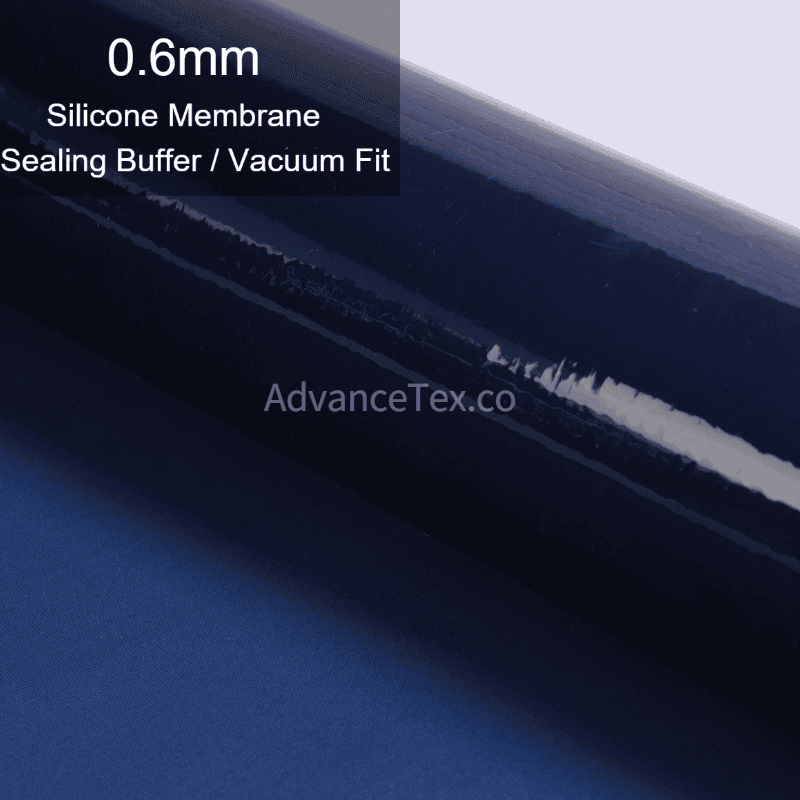
In 3D vacuum thermal transfer processes, transfer media must maintain uniform, intimate contact with workpiece surfaces under elevated temperatures and negative pressure. Conventional woven fabrics lack elasticity to conform to three-dimensional profiles.
Silicone elastic fabric (textile-backed silicone membrane) is a high-elongation elastic fabric with a synthetic-fiber textile backing and a silicone coating on one face, offering resilient recovery and high-elongation vacuum sealing.
For vacuum heat transfer operations, 0.6mm and 1.2mm thicknesses are engineered for distinct draw depths, contour profiles, and cycle frequencies.
1. 0.6mm Specification: Deep-Cavity Conformity and Anti-Bridging
The 0.6mm silicone elastic fabric features low tensile resistance and rapid elongation. Under negative pressure, it conforms swiftly with minimal drawing force.
Core Engineering Advantages
- Void and Bubble Elimination: For workpieces with deep recesses, sharp internal radii, or multi-curved profiles, the 0.6mm fabric conforms closely into inner corners. This prevents "bridging" (fabric spanning across corners without bottoming out) and ensures full surface contact with the transfer paper.
- Uniform Pressure Distribution: The flexible, low-gauge profile delivers consistent normal pressure across complex geometry, preventing ghosting, pattern shifting, or uneven color density caused by fabric bunching.
Typical Applications
- 3D phone cases, electronic enclosures, contoured hardware, and craft workpieces with intricate surface geometries.
- Vacuum membrane presses requiring high precision around tight corner radii.
2. 1.2mm Specification: Tear Resistance, High Negative Pressure, and Puncture Protection
The 1.2mm silicone elastic fabric features a thicker silicone membrane layer, enhancing mechanical stability and wear margins.
Core Engineering Advantages
- Long-Cycle Fatigue Resistance: In continuous industrial production with frequent clamping cycles, the thicker construction minimizes stress relaxation and sagging under sustained heat, extending service life.
- Puncture and Abrasion Resistance: For workpieces featuring distinct edges or raw metal perimeters, the thicker silicone layer absorbs localized stress and resists piercing, preserving vacuum integrity.
- Perimeter Sealing and Cushioning: Provides superior compression resilience along clamping frames, preventing air leakage under high negative pressure.
Typical Applications
- Aluminum profiles, architectural panels, flat cabinet doors, and shallow-draw components (e.g., wood-grain and stone-grain sublimation).
- High-volume, continuous industrial sublimation lines.
3. Key Selection Comparison
| Selection Factor | 0.6mm | 1.2mm |
|---|---|---|
| Workpiece Geometry | Deep cavities, tight radii, complex compound curves. | Flat panels, shallow draws, wide radii, sharp-edged profiles. |
| Primary Engineering Goal | Eliminate air pockets, avoid corner bridging, maximize print definition. | Maximize cycle life, resist edge puncture, maintain frame sealing. |
| Tensile Resistance | Low (stretches rapidly under lower vacuum levels). | Moderate to firm (requires higher negative pressure; higher return force). |
| Mechanical Durability | Standard (protect against direct scratching by sharp points). | High (substantial wear layer for repetitive contact). |
4. Operational and Maintenance Guidelines
- Thermal Balancing: Silicone undergoes modulus changes when heated to operating temperatures (typically 160°C to 200°C). Prior to initial production runs, preheat the membrane under low vacuum to condition the silicone membrane for initial heating and stretching.
- Controlled Draw Depth: Match workpiece height to membrane thickness. For deep parts, ramp up vacuum in stages to avoid over-stretching the 0.6mm membrane at corner apexes.
- Surface Cleaning: Regularly clean sublimation ink condensates and adhesive residues off the silicone surface. Chemical buildup can harden the elastomer, reducing flexibility and seal performance.